

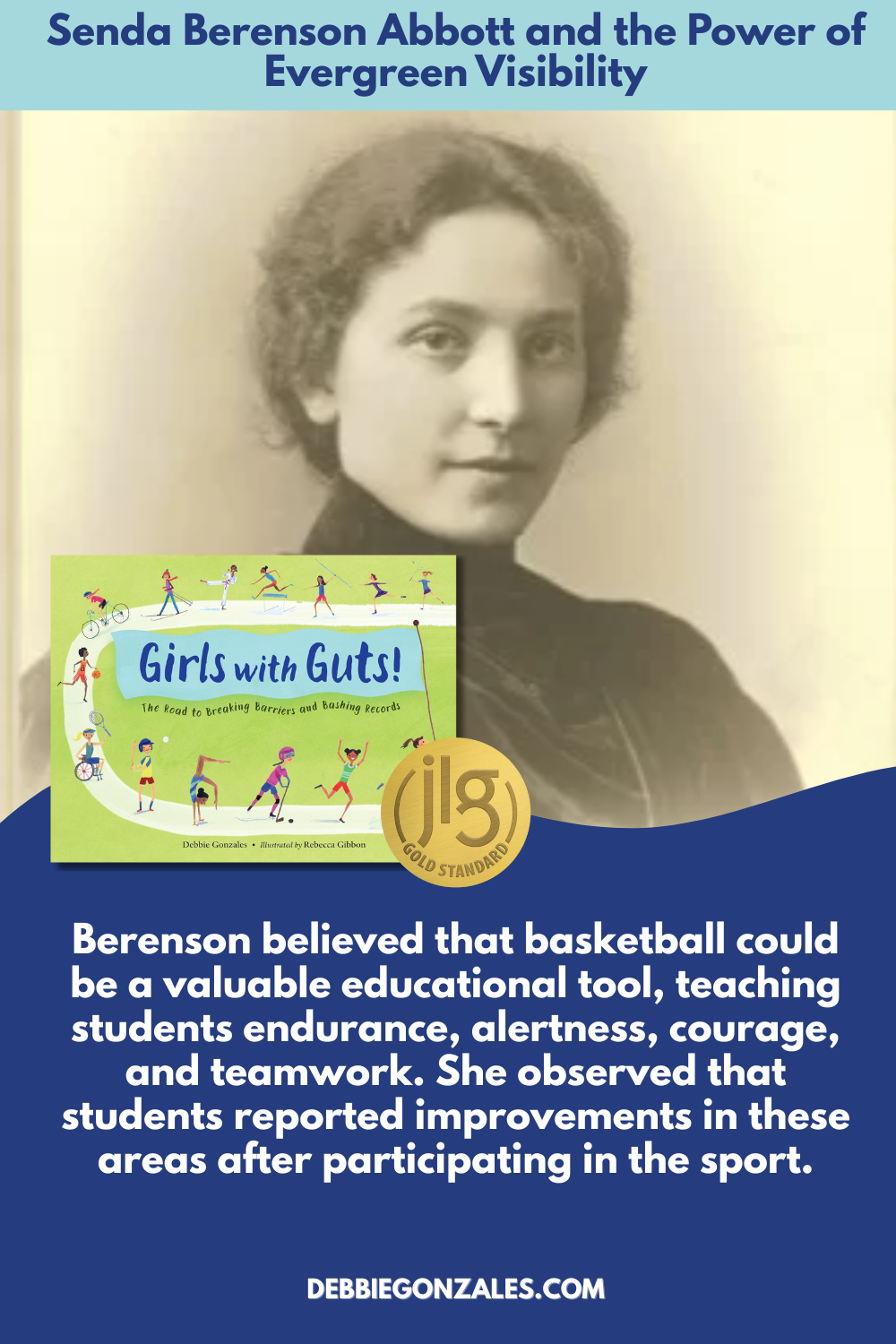
Every so often, I stumble across something that stops me in my tracks. That happened recently while I was gathering titles to include in a mentor text set for Girls with Guts!, my nonfiction picture book celebrating the courage and contributions of female athletes throughout history. One of the women featured in the book is Senda Berenson Abbott—often referred to as “the mother of women’s basketball.” She was the first to adapt the game for women, authored the first basketball guide for female athletes, and opened the door for generations of girls to step onto the court and play.
You’d think, given her legacy, that there would be shelves of books about her. So I did what any researcher would do—I checked all the usual places. Amazon. Google. WorldCat library catalogs. And what did I find?
Four.
Only four books mention Senda at all—and one of them is Girls with Guts!, where she’s honored in just a single spread.
Four books. That’s it.
Out of curiosity (and a little frustration), I decided to ask ChatGPT to help me dig deeper. And here’s where things got really interesting. Not only did Girls with Guts! come up as a top-ranking result for Senda Berenson Abbott, but two Pinterest pins I created way back in 2018—2018!—showed up at the top of the visual search. That’s the power of evergreen marketing. Old content remains new, forever.
When we talk about evergreen content, especially on Pinterest, we’re talking about material that continues to work for you long after you post it. Think of it like building a living, breathing indexed library. With the right strategy—optimized keywords, smart pin design, and meaningful content—your work can show up not just in Pinterest search, but in Google search and now, in AI results as well.
This is especially exciting for book creators. A well-built Pinterest platform isn’t just a collection of pretty pins. It’s a discovery engine. And when it comes to historical figures like Senda, it’s a way to keep their legacy visible and relevant to new generations of readers, educators, and researchers.
As for mentor texts—these are curated book lists that teachers, librarians, and authors use to model craft, structure, and theme. They're essential tools in both classroom and creative settings. Featuring your book on a mentor text list can expand its lifespan and visibility in the education market, especially if the book offers evergreen content that aligns with holidays, curricular themes, or historic moments.
I’ll be sharing more about Senda Berenson Abbott soon—her story deserves the spotlight. But for now, I just want to take a moment to celebrate this: Her legacy lives on. Not only in the pages of Girls with Guts!, but in libraries, classrooms, and even in AI results.
So if you’re building a platform—or wondering if your Pinterest posts are really “doing anything”—remember this: Every pin, every keyword, every meaningful story contributes to something bigger. With time and intention, your work will rise.
And if you’re wondering whether Pinterest is worth the effort?
Let Senda—and those two old pins—be your answer.